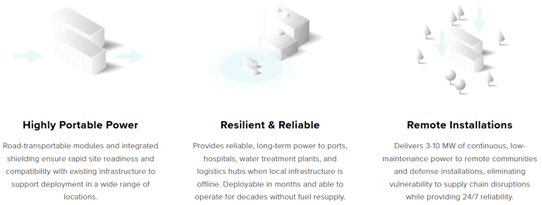
Use Cases: XENITH is aimed at providing resilient, off-grid energy for critical operations. Target use cases include remote communities, military bases, disaster-relief or emergency backup sites, and other mission-critical facilities that need independent 24/7 power. For example, the system is being developed with U.S. Department of Defense interests in mind (X-energy’s design builds on the DoD’s Project Pele program for mobile reactors). XENITH’s value proposition is reliable “plug-and-play” clean energy in locations where diesel generators or fragile grids are typical, improving energy security by eliminating fuel supply vulnerabilities and reducing carbon footprint. It also demonstrates the versatility of the company’s technology portfolio, potentially serving as a stepping stone for future advanced reactor designs in space or other constrained environments.
3. TRISO-X Fuel Supply
A key differentiator of X-energy’s business model is its vertical integration into fuel manufacturing. The company produces its own proprietary variant of TRISO particle fuel, called TRISO-X, which is used in all its reactor designs. TRISO (Tri-Structural Isotropic) fuel encases uranium fuel kernels in multiple layers of carbon and ceramic coatings, forming tiny, rugged particles that are then embedded in graphite pebbles. This design makes the fuel extremely robust: each particle is a self-contained system that can withstand very high temperatures without melting and without releasing fission products. In practical terms, TRISO-X fuel cannot melt down, even under accident conditions, which dramatically enhances reactor safety and eliminates the need for large external containment structures.
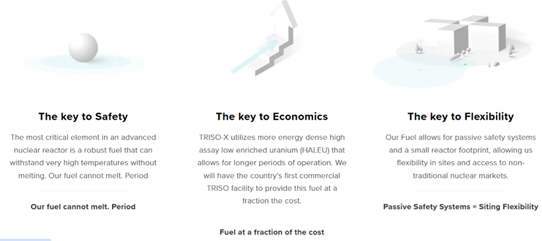
Fuel Fabrication Facility: To ensure a reliable fuel supply for its reactors, X-energy is constructing North America’s first commercial advanced nuclear fuel fabrication facility dedicated to TRISO fuel in Oak Ridge, Tennessee. This TRISO-X fabrication plant will produce high-assay low-enriched uranium (“HALEU”) fuel pebbles for the Xe-100 fleet and other potential advanced reactors. Owning the fuel cycle allows X-energy to control fuel quality, cost, and availability, a strategic advantage as many emerging reactor developers must rely on external or government-supplied HALEU fuel. By vertically integrating fuel production, X-energy can supply its customers with fuel at predictable costs and avoid supply bottlenecks. This not only creates an additional recurring revenue stream but also supports reactor deployment. Reactor sales directly drive fuel demand, helping justify the investment in the TRISO-X facility. X-energy’s TRISO-X team includes veterans of past TRISO programs, and the company reports achieving higher fuel production yields and multiple patents by innovating on the decades-old TRISO fabrication processes.
4. Operating & Maintenance Services
Beyond reactor hardware and fuel, X-energy is developing an operations and support services segment to aid customers in deploying and running their reactors. A key initiative is the establishment of regional Plant Support Centers, the first of which (PSC-East in Maryland) will serve as a fleet management, remote monitoring, and training hub for early Xe-100 installations. Through these centers, X-energy plans to centralize operational support for its reactor fleets: providing real-time oversight of plant performance, operator training (via simulators and virtual reality tools), maintenance planning, and outage support from a central location. This model takes inspiration from fleet operations in industries like aviation or power utilities and is enabled by modern “digital twin” technology and analytics (X-energy’s proprietary X-DATA™ platform) to optimize maintenance and uptime.
Business Model Benefits: The centralized services model is designed to improve the value proposition of X-energy’s reactors for customers and for the company. By lowering operating and maintenance costs through shared support infrastructure and advanced analytics, it makes the Xe-100 plants more cost-competitive for end users. For X-energy, these long-term service agreements create a recurring revenue stream beyond the initial reactor sale. In practice, once multiple Xe-100 units are deployed, X-energy envisions expanding these support centers into a network of hubs supporting all owners/operators of its reactors. This full-lifecycle approach, selling the reactor, providing the fuel, and then supporting operations, aligns with the company’s commercialization goals by enhancing customer confidence through guaranteed fuel supply and expert operational support and by shortening deployment timelines.
Overall Strategic Alignment
All of X-energy’s business lines are interrelated and geared toward one mission: commercial deployment of next-generation nuclear technology. The advanced reactor designs (Xe-100 and XENITH) drive demand for the TRISO-X fuel; the in-house fuel capability, in turn, guarantees that reactor projects have the necessary fuel available safely and cost-effectively. The support services ensure that once deployed, the reactors can be operated efficiently and reliably over decades, addressing a traditional pain point of nuclear power (high operating costs and complex operations) with a new model of centralized fleet management. Together, this integrated model supports X-energy’s goal of making nuclear energy accessible, affordable, and deployable in new markets. This vertically integrated approach positions X-energy as not just a reactor vendor but a full-service nuclear energy company that enables deployment of clean, zero-carbon power on a global scale.
HOW X-ENERGY DIFFERENTIATES ITSELF
X-energy is in a leadership position in the nascent advanced nuclear industry, with several competitive advantages that differentiate it from other SMR developers. Key aspects of its edge include:
Regulatory Head Start: Navigating the NRC licensing process is one of the most challenging aspects of commercial nuclear innovation and X-energy’s progress with the gives it a multi-year regulatory head start. X-energy will leverage work done for the Dow plant to accelerate follow-on projects through regulatory approvals. Licensing experience and credibility with regulators are major competitive assets for X-energy.
Integrated Fuel Supply (Barriers to Entry): X-energy is the only SMR company with a proprietary fuel and its own dedicated fuel fabrication facility under construction. This vertical integration is a critical moat. TRISO fuel production at commercial scale requires specialized expertise and licensing that X-energy has been developing for years. In contrast, most rivals must rely on government labs or foreign suppliers for advanced fuel (especially HALEU-based fuels), which could become a chokepoint. By controlling TRISO-X fuel, X-energy ensures security of supply for its reactors and can potentially sell fuel to other reactor programs in the future. The sizable capital and time required to build a facility like TX-1 (>$300M and ~5 years for licensing/construction) set a high barrier to entry that latecomers will struggle to overcome.
Blue-Chip Customers & Validation: X-energy’s roster of marquee partners (Dow, Amazon, Energy Northwest, Centrica, OPG) is unique in the industry and confers significant advantages.

• Amazon - First Hyperscaler on Board: X-energy signed on Amazon not only as a customer but as a significant investor in the Series C round. They will provide a pipeline of projects expected at more than 5GW but also serves as a strong endorsement of X-energy’s commercial viability in the eyes of other corporations, utilities, and governments. Amazon has committed to support an initial 320-megawatt project with Energy Northwest, a major utility company, in central Washington. It creates a network effect: suppliers, financiers, and talent are eager to align with the SMR company that has Amazon’s backing. This could make it harder for competitors to get comparable traction.
• Dow - Industrial First-of-a-Kind: The Dow project was a first of a kind project for a four-unit Xe-100 plant at Dow’s Gulf Coast chemicals manufacturing site providing early validation from the industrial sector. Dow conducted extensive due diligence before choosing X-energy, indicating confidence in the technology’s readiness which sets X-energy apart from its peers. The project is supported by the U.S. DOE ARDP which is designed to accelerate the deployment of advanced reactors through cost-shared partnerships with U.S. industry. Executing the Dow project will further entrench X-energy’s lead, as it will gain real operational data and lessons learned that others lack.
• Centrica - Expanding Internationally with Utility Partner: Centrica, a leading UK energy services and solutions company, partnered with X-energy to explore the deployment of up to 6 GW of advanced nuclear capacity in the UK using the Xe-100 reactor platform. The partnership envisions fleet-scale deployments across the UK, supporting both grid decarbonization and industrial energy resilience. Centrica’s backing lends significant institutional credibility to X-energy’s global expansion efforts and positions the UK as a potential anchor market for future exports.
• Ontario Power Generation (“OPG”) – Early Technology Partner: OPG has been a long-standing partner with X-energy since 2020 and after significant due diligence, OPG became an investor and board member. OPG is one of North America’s most experienced and respected nuclear operators. The two organizations collaborate closely on advanced reactor development, with OPG providing technical insight, regulatory support, and fleet deployment expertise. As OPG continues to advance its own SMR roadmap in Canada, this relationship could credibly evolve into a commercial order, reinforcing X-energy’s position as a leading SMR platform on both sides of the border.
Technology Maturity and Focus: Among advanced reactor designs, X-energy’s technology is relatively mature and well-understood. The basic concept (pebble-bed high-temperature reactor) has decades of R&D and even operational experience (e.g. Germany’s AVR, China’s HTR-PM). X-energy has been able to build on proven principles, reducing technical novelty risk. By contrast, some competitors are pursuing more exotic concepts (e.g. molten salt or fast reactors) that still face fundamental R&D questions. X-energy’s focused approach allows it to channel resources effectively and hit milestones on time. This could translate to higher likelihood of delivering projects on-budget and on-schedule.
Public-Private Alignment: X-energy benefits from a strong alignment of interests with government objectives, which many competitors do not have at the same level. Being an ARDP awardee means X-energy’s success is tied to a U.S. national goal of regaining nuclear leadership. This has opened doors for X-energy: preferential access to DOE labs, additional funding opportunities (e.g. DOE loan guarantees or state incentives), and policy support. For example, the U.S. government is actively working to establish fuel supply for X-energy and others, mitigating a supply risk for its reactors. X-energy has expanded globally with partnerships with OPG in Ontario and the UK who has put in orders of the Xe-100. X-energy’s project sites (Texas, Washington) enjoy bipartisan political backing (Texas for industrial jobs, Washington for clean energy and tech) which can expedite permitting and appropriations. This public-private partnership model acts as a competitive moat.
Economies of Scale & First-Mover Advantage: When X-energy executes its first few projects, it will gain significant economies of scale in manufacturing and construction. The company aims to standardize the Xe-100 units and reproduce them across many sites. Being first to deploy means X-energy can iterate designs, optimize the supply chain, and drive down costs while others are still in prototype stage. This first-mover advantage could enable X-energy to dominate market share in advanced nuclear, as customers often gravitate to the solution with a track record. Moreover, as X-energy builds reactors, it will generate revenue and cash flow to reinvest in further growth, potentially outpacing less capitalized competitors. The network effect of more deployments could also improve financing terms (lower risk perceived by lenders/insurers), again reinforcing X-energy’s lead.
WHAT MAKES X-ENERGY AN ATTRACTIVE INVESTMENT?
Stack Capital’s investment thesis for X-energy centers on the conviction that now is a pivotal moment for advanced nuclear energy, and X-energy is uniquely positioned to lead (and benefit from) the sector’s emergence. This is in addition to the U.S. Federal Government’s push modernize nuclear regulation, streamline nuclear reactor testing, deploy nuclear reactors for national security, and reinvigorate the nuclear industrial base. Our $5 million investment was driven by the following key considerations:
Timing & Inflection Point: We believe X-energy is at an inflection point where over a decade of R&D is converging with urgent market demand for reliable, clean power. The world’s energy landscape is undergoing a transformation – with AI, electrification, and climate goals putting unprecedented pressure on the grid, and it is happening faster than legacy solutions can adapt. Advanced SMRs like the Xe-100 are moving from concept to reality at exactly the time they are most needed. X-energy is now pouring concrete for a fuel plant and has real reactor projects in the pipeline. This significantly de-risks the company compared to early-stage ventures. Investing after the technology has already been proven but before full commercialization offers an attractive risk-reward profile.
Strong Management: We place considerable weight on X-energy’s leadership and stakeholder group. The management team has a rare blend of entrepreneurial, technical, and governmental experience. They have consistently demonstrated pragmatism, for example, pivoting the ARDP demo to Dow’s site to ensure a customer use-case, and raising ample capital when an attempted SPAC didn’t materialize. With the addition of Daniel Gross CFO who was with Amazon and sat on the company’s board, they prepare for the next phase of growth for X-energy.

Stakeholder Cohesion: Having investors like Ares, ARK, and strategic partners like Amazon, OPG, and Dow as equity holders aligns interests for the long term. These partners bring not just money but resources and accountability. In Stack’s assessment, this reduces execution risk and increases the likelihood of successful commercialization. It’s rare for a company to have such heavyweight partners across its value chain and involvement with businesses like Amazon ensure that X-energy’s product is designed to meet real customer specs, not in a vacuum. We also take comfort that the DOE is effectively a partner via cost-share, this means some downside protection in initial projects and a source of expert support (national labs etc.). Overall, the caliber of stakeholders around X-energy gives it a strong foundation to navigate challenges, which is central to our investment thesis of risk-adjusted return.
Public-Private Alignment & Policy Tailwinds: X-energy embodies a model of public-private partnership that greatly enhances its chances of success. The alignment of interests between government (DOE, NRC), industry (Dow, utilities), and tech (Amazon) provides a powerful support network. This means X-energy can leverage funding, expertise, and political goodwill from multiple fronts. We see strong bipartisan and global policy support for what X-energy is doing: the U.S. and other nations have explicitly stated goals to deploy advanced nuclear. The Inflation Reduction Act’s production tax credits for nuclear, DOE loan guarantee programs, and international initiatives (like Canada and UK’s SMR deployment plans) all create tailwinds for companies like X-energy. This alignment reduces regulatory and market adoption risk – regulators want X-energy to succeed, and customers are being incentivized to choose nuclear. Stack’s investment thesis counts on this favorable policy environment persisting, effectively giving X-energy a tailwind that many high-tech ventures do not have.
Differentiated Technology with Massive Upside: From an investment perspective, X-energy offers a differentiated solution in a field with high barriers and potentially winner-take-most dynamics. Notably, the nuclear reactor is safe from traditional meltdowns and only requires a 400m safety perimeter allowing significant flexibility in how it’s deployed. If advanced nuclear captures even a modest fraction of the future energy mix to meet global net-zero and power needs, the market for SMRs will be measured in hundreds of gigawatts and hundreds of billions of dollars. X-energy’s technology with its inherent safety, modularity, and dual-use (power + heat) capability, is one of the few that can realistically address this market in the near term. The successful commercialization of X-energy’s offerings could lead to high-margin recurring revenues through long-term fuel supply, services, and perhaps power sales if X-energy retains equity in projects.
Energy Transition Growth: X-energy benefits form the decarbonization and energy transition theme. Clean consistent power is one of the hardest problems to solve in achieving climate targets and sustaining digital economy growth. X-energy would enable companies and economies to grow sustainably, powering AI, electrified transport, industry without emissions, while providing base load energy that wind/solar+storage alone may not fully cover. The infrastructure-like nature of its business (building plants with 60-year lifespans and regulated-like returns) could yield stable long-term cash flows or an attractive takeover target for large energy companies. At the same time, the growth potential (multi-GW pipeline) puts it in a growth equity category.
CONCLUSION
Stack Capital’s investment in X-energy reflects conviction that the company combines the right technology, market alignment, and execution model to expected growth in clean, reliable nuclear energy. The Xe-100 reactor platform, which is intrinsically safe, modular, and engineered for manufacturability, addresses fundamental limitations of traditional nuclear while solving urgent new demands driven by AI-scale data infrastructure, industrial decarbonization, and grid resilience.
X-energy’s vertically integrated model, anchored by its proprietary TRISO-X fuel supply chain and early commercial traction with customers like Amazon, Dow, and Energy Northwest, positions it well ahead of peers. With nearly $3 billion in combined public and private support, critical NRC milestones in motion, and a growing pipeline of multi-GW deployments, X-energy is transitioning from concept to infrastructure.
For Stack Capital, this is a great opportunity to invest at the convergence of breakthrough technology, policy momentum, and demand pull with capital discipline. We view X-energy as a platform-level bet on the future of advanced nuclear, and a strategic entry into the power backbone of the AI and electrified economy.
%20V3.png)